Cels is a ready-made platform for building IoT systems fast, with no dependency on specific hardware and no need to write code.
💡
Cels helps companies of any size launch IoT projects: from prototype to industrial operation in days, not months.
Why Most IoT Projects Fail
Building an IoT system from scratch usually means:
- Months or years spent building your own infrastructure
- Being locked into specific hardware, so swapping equipment means rebuilding the whole system
- An architecture that can't handle growth in devices or load
- Needing a programmer for every small change
Cels removes all of this. The platform launches in days or weeks, works with any device or protocol, scales without architectural changes, and lets you adjust business logic with no code at all.
What Cels Actually Is
Cels is a server-side Application Enablement Platform (AEP), the central layer of any IoT architecture.
It connects devices, networks, and applications into one system: pulling in data, normalizing it, adding context, storing it in a single model, and routing it where it needs to go.
What the Platform Does
- Connects and manages devices across 20+ protocols
- Normalizes telemetry into one unified model
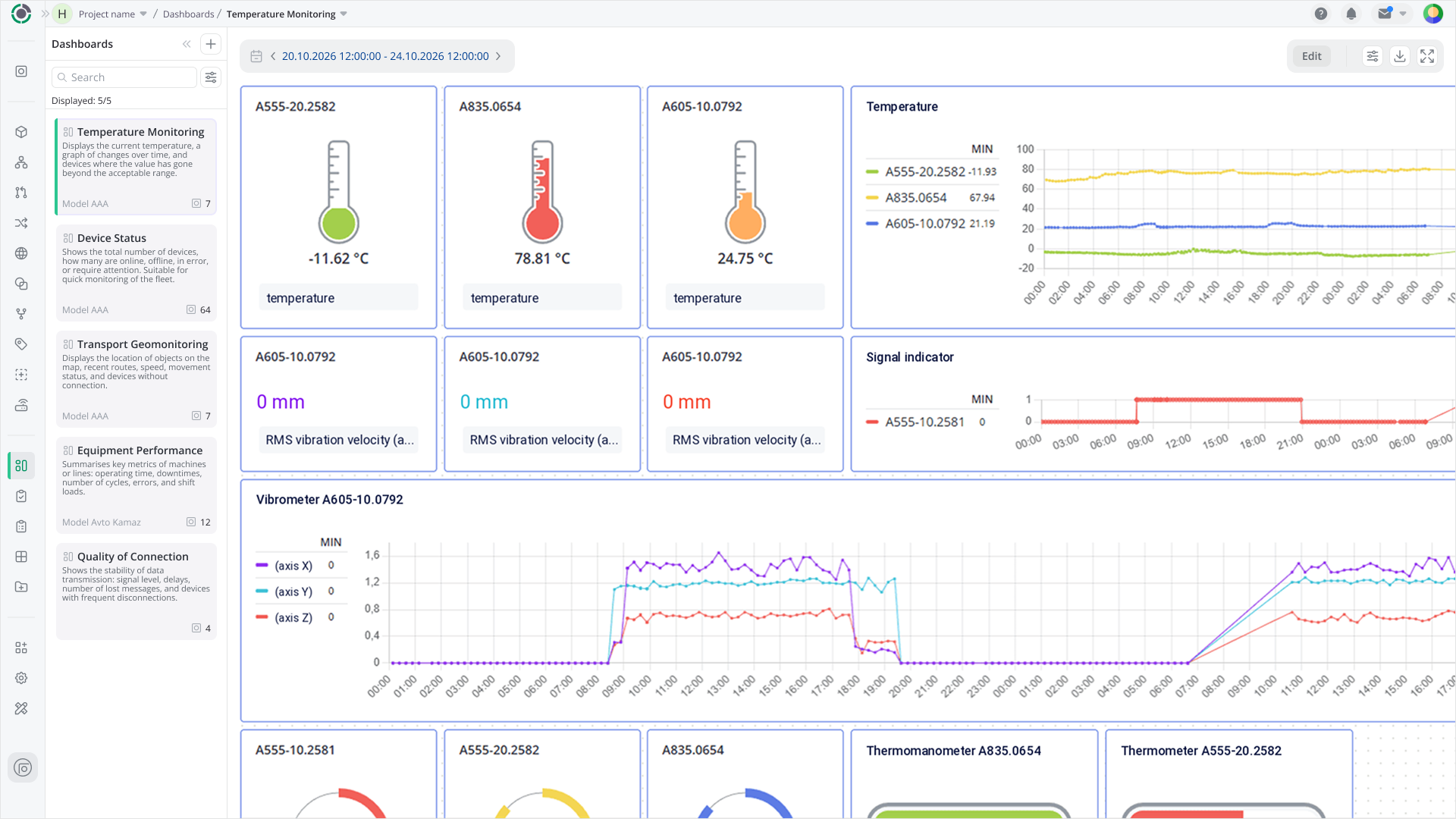
- Automates business logic with a no-code, graphical editor
- Integrates via REST API and SDK with ERP, CRM, MES, SCADA, and other systems
- Secures everything with two-factor authentication, X.509 certificates, TLS encryption, and role-based access
Put simply, Cels acts as an intermediary layer between field devices (sensors, actuators, and other equipment) and business applications.
Core Idea
An IoT solution isn't just sensors. It's four layers working together:
- Devices: measure parameters, record state, and perform control actions
- Networks and communication channels: deliver data from devices to the server layer
- The server layer (Cels): receives, normalizes, stores, and processes data
- Applications and integrations: turn data into clear interfaces, reports, notifications, and actions
The server layer is what turns a mixed set of devices and networks into a manageable, scalable system.
Without a platform, IoT remains a set of isolated data points.
12 Unique Advantages of Cels
1. Automation
No-code automation based on state machines
Unlike platforms that only offer simple "if-this-then-that" rules, Cels provides a visual editor for finite state machines.
It makes complex system behavior easier to describe: multiple states, transitions, conditions, and actions can be configured without writing code.
Scenario development time is reduced from weeks to hours. Business analysts and engineers can create and change logic themselves, without involving developers.
2. Compatibility
Multi-protocol connectivity without vendor lock-in
Cels is not tied to a specific hardware manufacturer or protocol.
It supports 20+ protocols out of the box, including MQTT, LoRaWAN, telematics protocols, CoAP, WebSocket, and others.
New protocols can be added when a project needs them.
Freedom to choose hardware. The ability to change device suppliers without rewriting the IoT system. Protection of investments from technology lock-in.
3. Methodology
An 8-stage methodology for building IoT solutions
Cels combines platform tooling with a structured methodology for creating IoT systems.
The 8 stages are Connectivity, Abstraction, Normalization, Beneficiation, Automation, Integration, Presentation, and Separation.
This gives projects a clear and predictable path from idea to working system.
Lower implementation risk. A clear and predictable path from idea to working system. The ability to assess the maturity of a current IoT solution.
4. Completeness
Everything in one place, from connectivity to service workflows
Cels covers the full IoT project cycle: device connectivity, data processing, automation, visualization, integration with external systems, and task management for field teams.
There is no need to assemble a solution from unrelated products and technologies.
A single point of responsibility. Lower integration and operating costs for fragmented systems. Faster project launch.
5. Ready-Made Solutions
Vertical solutions for real industries
Cels is more than a toolkit.
It can be used as the foundation for ready-made industry solutions: equipment monitoring, fleet monitoring, personnel tracking, warehouse monitoring, car sharing, scooter sharing, and other connected services.
Proven solutions in production. Mobile apps, an administrative panel, and business logic can be ready to adapt for a specific customer instead of built from scratch.
6. Architecture
Digital twins and device shadows
Cels uses object models as an abstraction layer between business logic and specific hardware.
A model describes parameters, commands, and events, rather than the protocol of a particular device.
The same scenario can work with different types of equipment.
Business logic stays independent from hardware. Devices can be replaced without rewriting scenarios. Teams get one interface for a mixed equipment fleet.
7. Field Team Management
Task management for service and operations teams
Many IoT platforms stop at monitoring and automation.
Cels can also support task workflows for field teams, including mobile scenarios for employees.
Tasks can be created automatically from device events and assigned to responsible people.
The loop is closed: issue detection, automatic task creation, completion, and confirmation. There is no need to buy a separate system for managing service teams.
8. Data Processing
Data handling without deploying extra servers
Cels includes tools for writing serverless JavaScript data handlers directly in the platform.
Teams can filter, enrich, and calculate indicators without deploying separate microservices or servers.
Custom data processing logic can be implemented quickly. Simple tasks do not require separate DevOps infrastructure. Testing and debugging happen in the interface.
9. Positioning
Hybrid positioning: GNSS and indoor tracking
Cels supports indoor positioning alongside classic GNSS tracking.
Teams can upload floor plans, place BLE beacons, calculate coordinates inside buildings, and work with geofences that take floors into account.
Assets can be monitored inside facilities such as warehouses, production sites, offices, and retail floors. Outdoor and indoor monitoring work in one system, without a separate indoor positioning product.
10. IoT Maturity Levels
One platform for every stage of IoT maturity
Many IoT products cover only the first levels: monitoring and reporting.
Cels helps teams move through the full digital maturity ladder within one platform:
- Visibility: device connectivity, telemetry collection, visualization
- Insight: analytics, reports, pattern detection, predictive maintenance
- Optimization: automation, control, cost reduction
- Transformation: servitization, autonomous systems, new business models
There is no need to change platforms as the project grows. Teams can start with monitoring, then add automation, analytics, and AI while preserving investments in development, training, and integration.
11. IoT Value Chain
All 6 IoT value drivers in one system
Cels supports the full IoT value chain, from objective operational control to service-based business models:
- Objectivity: automatic data collection and reduced human-factor risk
- Traceability: history of business-process events, logs, tracks, and reports
- Predictability: forecasting states and events in business processes
- Resource efficiency: better utilization of assets and resources
- Adaptive automation: flexible scenarios that react to changing conditions
- Servitization: transformation of products into service models
Instead of separate products for monitoring, analytics, and automation, teams get everything in one platform, reducing total cost of ownership and simplifying integration.
12. Future-Ready IoT
Prepared for IoT 2.0 and autonomous systems
Cels is designed for the evolution of IoT toward autonomous systems, where devices and processes can make decisions with less human involvement.
Its model architecture, automation scenarios, handlers, integrations, and AI-ready foundation support the creation of self-managing systems.
The platform is ready for the next stage of IoT. Today you build monitoring, tomorrow automation, and later an autonomous system without changing the technology stack.